Elaine Sanders
Journalist & Photographer

Farewell to the Big A
Text and photographs by Elaine Sanders
fter 131 years, New York City’s last horse race track, Aqueduct Racetrack, will host its final race on June 28, 2026. Though not that many in the city even know it exists, the track’s dedicated attendees have already begun to mourn its demise and the world that will be lost with its closure.
Horse racing has always had a strong presence in New York; Queens County is considered the birthplace of American horse racing with the first formal and measured Newmarket Racecourse opening in 1665. In the 1800s, there were eight racecourses operating throughout the five boroughs, Aqueduct being one of five tracks in Queens. Just outside current New York City limits, Belmont Park in Nassau County and Empire City Race Track in Yonkers were popular facilities for racegoers of the time. Now, only two of these fixtures of downstate horse racing survive: Belmont Park and Aqueduct.
Belmont Park – home to the final leg of the Triple Crown, where spectators must dress according to a code demanding elegance and class – is just nine miles away from the Aqueduct and across the county line. But it could be a world away. Aqueduct is for the everyman.
Also known as “The Big A,” the track has always been a venue where trainers with modest-sized operations, apprentice jockeys, and less costly horses have a place to compete and make a name for themselves. This is particularly evident in the winter months when the more expensive horses and leading trainers move their operations to Florida for their seasonal migration to better weather. It is not easy to train and maintain horses in the bitter cold, and only the most dedicated fans brave the cold to watch – and bet – from the crumbling grandstands.
Although most of its races are for lesser purses and hold smaller fields, particularly in more recent years, The Aqueduct is known for more significant races like the Wood Memorial–an important preparatory race for the Kentucky Derby, the winner is guaranteed a spot in the Derby. Several greats have run its track, like Man O’ War, Seabiscuit, Ruffian and Secretariat, which claimed the first win of his career at the track in 1972. And of all places to officially retire and celebrate the famed thoroughbred, Secretariat’s owners chose the Big A, which brought out a crowd of 32,000 fans in 1973, after his dominating, triple-crown win.
Today, the crowd usually numbers about 2,000; regulars who show up for the thrill of the race, to make a buck, and to see friends.
But no amount of dedication can save the Big A; the writing has been on the wall for years. When Resorts World Casino operated by Genting opened in 2011 in part of Aqueduct’s grandstand, rumors started spreading that The Big A would be closing. In September 2025, Genting’s proposal to take over the lease of Aqueduct’s 210 acres to expand the casino, add a multi-use event space, and build affordable housing was approved by the New York City Community Advisory Committee.
New York Racing Association (NYRA) leadership, which runs Aqueduct, Belmont Park and Saratoga Racecourse, has been talking about consolidating its two downstate tracks since around 2012. Current NYRA Chair Marc Holliday has been a big proponent of maintaining only one track, and is currently overseeing the transformation of Belmont Park (set to open in September 2026) with a $455 million state investment. Last week, NYRA officially announced the 2026 racing calendar, and with it, the final day of racing at the Aqueduct.
This is a photo essay about the last days of New York City’s last horse race track.
A

First opened in 1894, Aqueduct Racetrack sits on land formerly owned by the Brooklyn Water Works. The land held a conduit that brought water from Long Island to New York City, inspiring the name Aqueduct racetrack and its parallel street, Conduit Avenue. Located off the Far Rockaway-bound A train, it has its own subway stop. In the 1970s, an express A train, called “The Aqueduct Express” would take passengers from 42nd street all the way to the track with only one stop in Brooklyn for the price of one dollar- today there are 18 stops between 42nd and Aqueduct-North Conduit station.
Fans from across the five boroughs can get to the track and in the grandstands for the price of a subway fare, making it accessible and cheap entertainment. Other tracks, like Belmont Park, charge entry and parking fees and cater toward a higher-end clientele.

Aqueduct had its last major renovation in 1959. On opening day after the construction was finished, the track drew a crowd of over 42,000 people. Now, the grandstand holds only a few thousand fans, on a good day. The entryway escalators frequently stall out, leaving a security officer posted at the bottom to switch the direction of the singular working escalator as the crowd enters and leaves the building.

Traditionally, Aqueduct has three racing seasons: Fall (Nov-Dec), Winter (Jan-March), and Spring (April). Aqueduct’s winterized dirt track was first unveiled in 1975, making it the only New York track to offer winter racing, allowing the New York racing circuit to compete year round.
With Belmont Park under construction, since 2022 Aqueduct has picked up Belmont’s fall and spring/summer race seasons under the name “Belmont at the Big A.”


LEFT: Ruben Silvera riding, soon-to-be-winner Steel Vengeance, trained by Wayne Potts, to the starting gate for the second race on March 9, 2025. Silvera is a regular at the Aqueduct; he rides multiple races at the track every weekend, frequently teaming up with trainers Rudy Rodriguez and Linda Rice who are fixtures of year-round racing in New York. Silvera has won more than 1,300 races over his 14-year career, remarkably winning all six of the races he rode in at the Aqueduct on December 13, 2025.
RIGHT: Harry comes to the track only on big race days, like April 5, 2025, for the 100th running of the Wood Memorial, Aqueduct’s biggest race of the season. He considers himself a “bloodline bettor,” meaning he decides which horse to put his money on after studying the horse’s pedigree. He wears a lucky horseshoe ring given to him by his uncle.

When asked how long he’s been coming to the Aqueduct, Bob Bourget (yellow shirt) 75, answered with a smile and a chuckle, “a long time.” This is a common response among the regulars.
A horseman himself, Bob was a jockey in his home state of Massachusetts and Vermont in the 1960s as a teen before his growth spurt. “There is nothing like galloping a thoroughbred” he says.
He can be found Thursday through Sunday sitting in the sun, trackside, smoking a cigar. Despite the great deal of open benches, picnic tables and stadium seating, Bob brings his own folding chair. He sets up his spot alongside his buddy Kevin (blue shirt), both with Daily Racing Forms in their hands. Bob has read his form twice over and made his picks for the day before even stepping foot on the track.

Taken March 28, 1973 by Bob Coglianese, this winner’s circle photo shows a horse named Sitar, ridden by jockey Angel Santiago and trained by Robert DeBonis. Two months later, Santiago would ride against Secretariat in the Kentucky Derby on Twice A Prince, finishing twelfth. He went on to be the winning jockey of the Laurel Futurity aboard Protagonist that November. At the time of this photo, New York trainer Robert DeBonis was in his third year of training horses, this being one of four races won by horses he trained in 1973. DeBonis would go on to win 901 races and make over $15 million in winnings during his 27-year career.
The 1960s and 70s were popular years at the track, especially 1963-68, when Aqueduct hosted the Belmont Stakes while Belmont Park underwent renovations.

A relic from days past, the women’s restroom has an attached powder room. With the vast majority of patrons to the track being men, the women's room does not see much use. Unlike sections of Belmont Park, Aqueduct does not have a formal dress code, but that did not stop racing fans from dressing up at the track in the past. Now, a man in a suit stands out among the mass of ballcaps and T-shirts.


Attendance has been dwindling at tracks nationwide after the introduction of off-track betting in the 1970s, and subsequently with online betting in 2007.To keep audiences engaged, Aqueduct started offering simulcasting of races running across the country in 1987. Today, hundreds of TV screens lining the walls of the grandstands broadcast live racing from Santa Anita Park in California to Gulfstream Park in Florida. Fans can also place bets on these races at self-service terminals, online betting apps, or at the few remaining teller windows.
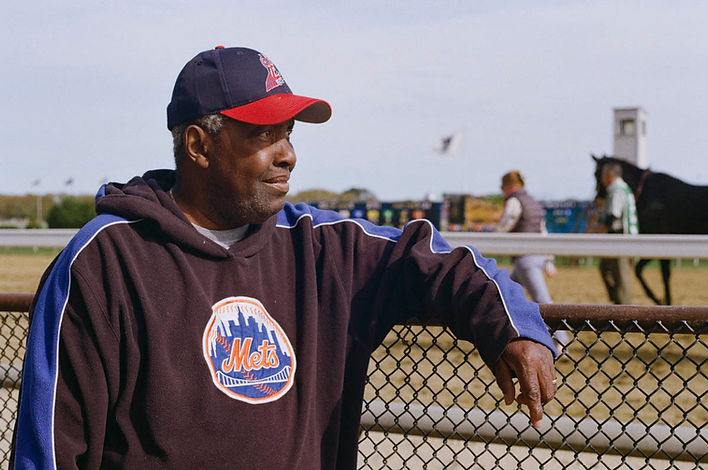
Originally from Trinidad and Tobago, Parker moved to the U.S. in 1972. Shortly after, he landed a job walking horses for trainer Richard Dutrow. He worked his way up the ladder from that entry-level position, striking out on his own as a trainer and racing horses under his name at Aqueduct in 2002.
Parker once owned a house across the street from the track, claiming “I would roll out of bed and right onto the backstretch.” He comes to the races almost every weekend, whether he has a horse running in a race or not, to spend afternoons with long-time friends. Parker says, “Aqueduct is the place to be, it’s where my heart lies.”

“Aqueduct is for the poor guy,” says Joe Parker. He says that people from all backgrounds come to the track, “Italians, Puerto Ricans, Venezuelans, Ecuadorians, Trinidadians, Jamaicans. Everybody's coming from every direction. What could be better than that?”


LEFT: As a part of its gradual shutdown, horses stopped living and training on Aqueduct in 2020. Instead, horses entered to race at the track are shipped in on semi trucks from Belmont Park. New York Racing Association trucks shuttle horses that are standing next to their competition they will race against only a couple of hours later. Shown here is the inside of one of these vans, carrying horses back to Belmont Park after running in a claiming race on a wet November day.
RIGHT: After a successful day at the track, Bob Bourget leaves in good spirits a few hundred dollars richer. Placing his cigar on the dash, he puts in a Best of Leon Russel CD in his radio. Windows down, enjoying one of the last hot days of the season, the song “Tryin to Stay Live” plays while he is driving out of the track on Conduit Road. “This is horse racing music,” says Bob.
